

ERPNext implementations don’t usually fail on Day One
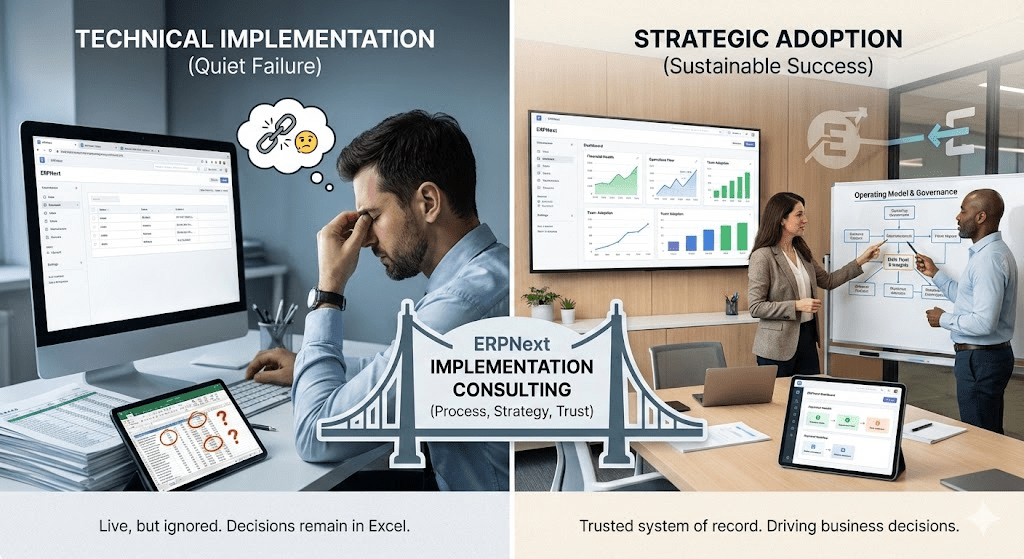
They fail quietly—six months later—when people stop trusting the system. The software is live. Transactions are happening. Reports exist.
And yet, decisions are still being made in Excel. That’s not a technical failure. That’s an implementation failure.
ERPNext consulting exists to prevent this exact outcome: a system that technically works but operationally doesn’t matter. This article breaks down why ERPNext implementations fail, what successful projects do differently, and why consulting—not configuration—is the real determinant of success.
The Hard Truth About ERPNext Implementations
ERPNext is adaptable, powerful, and Budget-friendly. That’s precisely why it’s risky. Flexibility without discipline doesn’t create agility. It creates Variability.
Most failed ERPNext implementations share the same pattern: the system was implemented correctly, users were trained, data was migrated, and The go-live was completed as planned.
And yet, adoption declined steadily. Why? Because ERP systems don’t fail when they go live. They fail when people lose confidence in the outputs. ERPNext implementation consulting is fundamentally about protecting confidence.
Why ERPNext Implementations Fail (And It’s Rarely the Software)
1. Businesses Automate Before They Decide
ERPNext is often deployed before leadership agrees on how approvals should work, who owns which data, what “good data” actually means, and how exceptions should be handled. When those decisions are deferred, ERPNext becomes a battleground for unresolved disagreements. The system doesn’t resolve ambiguity. It exposes it. Without consulting, companies automate indecision—and then blame the ERP for enforcing it.
2. Scope Is Driven by Features, Not Readiness
ERPNext is modular, which tempts teams to implement everything at once, including Accounting, CRM, Inventory, Manufacturing, HR, and Projects. On paper, this looks efficient. In reality, it overwhelms users and guarantees partial adoption. Successful ERPNext implementation consulting is ruthless about what not to implement. If users don’t trust core financial and operational data, adding more modules just multiplies confusion.
3. Customization Replaces Accountability
ERPNext customization is often used to avoid making hard business decisions. Instead of enforcing discipline, clarifying ownership, and simplifying workflows, teams customize the system to match existing chaos. This feels productive in the short term and becomes a long-term liability where upgrades become risky, support dependency increases, and internal ownership erodes. Consulting draws a clear line between necessary customization and avoidable compromise.
4. ERP Is Treated as an IT Project
ERPNext implementations owned by IT tend to focus on system stability, feature completeness, and technical correctness. However, ERPNext implementations owned by operations and finance focus on decision quality, data trust, and behavioral change. ERP is not an IT upgrade. It is an operating model change. ERPNext implementation consulting ensures the right people own the right decisions.
What ERPNext Implementation Consulting Actually Does
Let’s be precise. ERPNext implementation consulting is not about installing software, setting up fields, or running training sessions. Those are implementation activities.
Consulting sits above them. ERPNext implementation consulting focuses on operating model design, sequencing change, defining governance, protecting adoption, and managing organizational risk. The goal is not to “go live.” The goal is to make ERPNext the system of record people trust.
How Successful ERPNext Implementations Are Structured
Every successful ERPNext implementation follows the same underlying structure, whether Intentionally or not.
Phase 1: Discovery — Exposing Reality This phase answers one question: How does work actually happen today? Not how it’s documented, and not how leadership assumes it works. ERPNext implementation consulting identifies informal approvals, unofficial workarounds, duplicated data ownership, and points where trust breaks down. This phase is uncomfortable. That’s why it’s often rushed or skipped. Skipping it doesn’t save time. It just defers pain.
Phase 2: Process Design — Simplification Before Automation Before ERPNext is configured, processes must be simplified. This includes reducing approval layers, clarifying responsibilities, defining standard vs. exception flows, and agreeing on data ownership. ERPNext is not optimized for complexity. It’s optimized for clarity. Consulting ensures the system enforces decisions already made, not debates still unresolved.
Phase 3: Phased Implementation — Controlling the Blast Radius ERPNext should not be implemented in one massive rollout. Successful implementations stabilize finance first, bring core operations next, and layer advanced functionality later. Phased implementation allows for controlled adoption, data validation, behavioral adjustment, and confidence building. ERPNext implementation consulting protects teams from change fatigue by sequencing impact intelligently.
Phase 4: Adoption & Stabilization — The Most Ignored Phase Most ERP projects declare victory at go-live. That’s when the real work begins. Consulting during stabilization focuses on monitoring real usage, addressing resistance, fixing process gaps exposed by reality, and reinforcing discipline. ERPNext adoption is not about training users how to click. It’s about helping them understand why discipline matters.
Phase 5: Optimization — ERPNext as a Strategic Asset Only after stability exists should optimization begin. This entails better reporting, smarter automation, tighter controls, and performance improvements. ERPNext implementation consulting evolves into optimization consulting once trust is established. ERP is never “done.” It matures with the business.
What ERPNext Implementation Consulting Looks Like in Practice
Successful consulting engagements share common characteristics: fewer customizations, strong process ownership, clear escalation paths, explicit trade-offs documented, and leadership involvement beyond kick-off.
Consultants don’t aim to please everyone. They aim to protect the system. That tension is healthy.
Common ERPNext Implementation Mistakes Consulting Prevents
Without consulting, ERPNext implementations typically suffer from unclear ownership, inconsistent data standards, competing workflows, hidden workarounds, and eroded trust. Once trust is lost, no amount of technical improvement restores adoption easily. ERPNext implementation consulting exists to prevent trust erosion before it starts.
When You Need ERPNext Implementation Consulting
You should invest in ERPNext implementation consulting if this is your first ERP, growth has outpaced structure, multiple departments operate independently, leadership depends on accurate reporting, or the cost of wrong decisions is increasing.
ERPNext is affordable. Failed ERPNext implementations are not.
ERPNext Implementation Consulting Is Risk Management
ERPNext doesn’t fail loudly. It fails subtly: data becomes questionable, reports are ignored, teams revert to spreadsheets, and leadership stops trusting the system. At that point, the ERP still exists—but it no longer matters.
ERPNext implementation consulting is not an added cost. It is insurance against slow, silent failure. ERPNext will reflect your business exactly as it operates today. Consulting determines whether that reflection becomes a competitive advantage—or a liability you’ve automated.